Showing posts with label equivalents. Show all posts

Tuesday, November 28, 2006

Math Pretest Equivalents

Math Pretest

Convert the following values so that you can place them on the number line below. Show all your work.


0.175

55%

3:10

15/51

9:3


How could you determine whether the average of these numbers is greater than 10 or less than 10 without actually computing the average. Explain how you decided the average was more than or less than 10.

Monday, November 27, 2006

Scribe {Josh}

Today in class we had three things to do.

1. Make a T-chart for all of those numbers we converted for the number line.

2. Fix our number line.

3. The homework that was on the overhead.


For the T-chart {Assignment 2}

On the left side you put whatever you converted your numbers to {for the giant number line}. So if you converted all of them into percents that is what you would put on the left side. It's the same for fractions, decimals, and ratios.

On the right side you put the raw value. It's what the number was before you converted it.


What you had to do on the number line was to put markers.


If you did it in percent you would do 10% 20% etc. Same for fractions and ratios. Then put your numbers in between them.
This is the homework:
Equivalent Assignment 3
1. Convert the following percents into decimals, fractions and ratios. Then put them on a number line.
35.5% 12.6%1.67% 93.6% 48%2.
Convert the following decimals into percents, fractions and ratios. Then put them on a number line.
0.23 0.906 0.078 0.65 0.10643.
Convert the following ratios into fractions, decimals, and percents. Then put them in a number line.
1:7 4:5 9:56 7:3 10:14.
Convert the following fractions to decimals, percents and ratios. Then put them on a number line.
8/9 4/7 12/17 3/8 8/21
Personal reflection.
What is the easiest conversion for you to do in this equivalent unit? Why?
What is the hardest conversion to do in this unit. Why? What makes this conversion hard for you?
Choose 3 values to convert to practice what you find difficult. Practice makes perfect.
The next scribe will be: Allan

Thursday, November 23, 2006

April's scribe

APRIL'S SCRIBE POST
for november 22/06


Yesterday in class we did an Equivalents assignment on a big piece of graph paper. We had to place the following values below on a numberline with a group.


In my group (Me, April P. Josh and Jesse.) we converted the values into percents. We then put those percents also showing our work in numerical order from smallest to largest with its equivalent value. We then put the values on the numberline in numerical order, like we had on our seperate piece of paper.

Converting the values to percents.
50%
---- already a percent
3/4 ---- 3/4 - 3 divide 4= 0.75 x 100 = 75%
2:3 ---- 2:3=N/D - N=2 - D=2+3 = 2/5 - 2 divide 5= 0.4 x 100 = 40%
5/6 ---- 5/6 - 5 divide 6 = 0.83 x 100 = 83%
37.5% ---- already a percent
o.7 ---- 0.7 x 100 = 70%
9/10 ---- 9/10 - 9 divide 10 =0.9 x 100 = 90%
7:5 ---- 7:5=N/D - N=7 - D=7+5 = 7/12 - 7 divide 12 =0.58 x 100 = 58%
95.8% ---- already a percent
0.08 ---- 0.08 x 100 = 8%
17/40 ---- 17/40 - 17 divide 40 = 0.42 x 100 = 42%
0.484 ---- 0.484 x 100 = 48.4%
0.82 ---- 0.82 x 100 = 82%
17/200 ---- 17/200 - 17 divide 200 = 0.085 x 100 = 8.5%
80:30 ---- 80:30=N/D - N=80 - D=80+30 =80/110 - 80 divide 110 = 0.72 x 100 = 72% 29/47 ---- 29/47 - 29 divide 47 = 0.61 x 100 = 61%
66:34 ---- 66:34=N/D - N=66 - D=66+34 = 66/100 - 66 divide 100=0.66 x 100= 66%
80/108 ---- 80/108 - 80 divide 108 = 0.74 x 100= 74%
77:44 ---- 77:44=N/D - N=77 - D=77+44 = 77/121 - 77 divide 121 = 0.63 x 100 = 63%
18/92 ---- 18/92 - 18 divide 92 =0.19 x 100 = 19%

Values in Numerical Order
0.08, 17/200, 18/92, 37.5%, 2:3, 17/40, 0.484, 50%, 7:5, 29/47, 77:44, 66:34, 0.7, 80:30, 80/108, 3/4, 0.82, 5/6, 9/10, 95.8%

- note to mr harbec. the numberline wouldn't upload properly so i cant put it on the post =S
k i guess i'm done now.. so yeah.. the next scribe is....
JOSH S!
I think i spelled his last name wrong, but oh well

Tuesday, November 21, 2006

VANESSA'S SCRIBE

Today we spent most of the class writing this in our math notebooks:

FRACTIONS

Converting Fractions to Decimals
Divide the numerator by the denominator to get the decimal.
N/D=decimal
e.g.
¾ 3 / 4 = 0.75

Converting Fractions to Percents
There are two possible ways:
Multiply the numerator by 100 and divide it by the denominator.
N x 100 / D = Percent
e.g.
¾ 3 x 100 = 300

300 / 4 = 75%
OR
Divide the numerator by the denominator and multiply by 100.
N / D x 100 = Percent
e.g.
¾ 3 / 4 = 0.75

0.75 x 100 = 75%

Converting Fractions to Ratios
Part 1 : Part 2
Part 1 is the numerator.
Part 2 is the numerator subtracted from the denominator.
N : D-N
e.g.
¾ 3 : 1


DECIMALS
Converting Decimals to Fractions
Say the decimal then write it.
e.g.
0.42 (forty-two hundredths)
42/100

Converting Decimals to Percents
Multiply the decimal by 100
e.g.
0.42 x 100 = 42%

Converting Decimals to Ratios
Convert the decimal to a fraction first.
e.g.
0.42 → 42/100
Part 1 in the ratio is the numerator.
Part 2 in the ratio is the numerator subtracted from the denominator.
N/D N : D - N
e.g.
0.42 42/100
42 : 58
.........^100 - 42 = 58

PERCENTAGES
Converting Percents to Decimals
Divide the percent by 100.
% / 100
e.g.
57% / 100 = 0.57

Converting Percents to Fractions
The percent is already out of 100, so the denominator will be 100.
The actual percent is the numerator.
e.g.
57% 57/100

Converting Percents to Ratios
Part 1 is the actual percent
Part 2 is 100 subtracted by the percent
................(100 - % )
e.g.
57% 57 : 43
......................^ 100 - 57 = 43

RATIOS
Converting Ratios to Fractions
Part 1 + Part 2 = denominator
Part 1 = numerator
e.g.
7 : 3 7/10

Converting Ratios to Decimals
First convert the ratio to a fraction.
e.g.
7 : 3 → 7/10
Numerator is 7 because its Part 1. Denominator is 10 because part 1 + part = 10 ( 7 + 3 = 10 )

Then divide the numerator by the denominator to get the decimal
N / D = Decimal
e.g.
7 / 10 = 0.7

Converting Ratios to Percents
First convert the ratio to a fraction.
e.g.
7 : 3 7/10
Numerator is 7 because its Part 1. Denominator is 10 because part 1 + part 2= 10 ( 7 + 3 = 10 )
Then divide the numerator by the denominator to get the decimal
N / D = Decimal
Next multiply the decimal by 100 to get the percent
Decimal x 100 = percent

e.g.
7 / 10 = 0.7
0.7 x 100 = 70%

After you've finished copying the above information into your notebook, you need to write it again in the big paper, in rows 4 and 5.

Then we spent the last 15 minutes working on " Equivalents the Assignments. "

HOMEWORK
"Equivalents the Assignment"
4 questions, Mr. Harbeck already posted it (scroll down to last post)

Stuff we did so far and need to be completed (portfolio):
1. Equivalent Chart
2. Big Paper
3. Quiz
4. Equivalent Assignment

NEXT SCRIBE : April T

Equivalents the Assignment

Equivalents The Assignment

1. Make 4 different fractions using the digits below. You may only use each digit once. Convert these 4 fractions into decimals, percents and ratios.

1, 2, 3, 4, 5, 6, 7, 8, 9

2. Make 4 different decimal using the digits below. You may only use each digit once. Convert these 4 decimals into fractions, percents and ratios. (Do not use the decimals from the question above).

1, 2, 3, 4, 5, 6, 7, 8, 9

3. Make 4 different percents using the digits below. You may only use each digit once. Convert these 4 percents into fractions, decimals and ratios. (Do not use the fractions and decimals from the questions above).

1, 2, 3, 4, 5, 6, 7, 8, 9

4. Make 4 different ratios using the digits below. You may only use each digit once. Convert these 4 ratios into fractions, decimals and percents. (Do not use the fractions and decimals or percents from the questions above).

1, 2, 3, 4, 5, 6, 7, 8, 9

Monday, November 20, 2006

NOV 20 SCRIBE (PEE)

Today in math class, Mr. Harbeck gave us our third quiz. This quiz was based on our knowledge towards fractions.

Quiz 3


What do you know about 5/7?
- numerator is 5 (part)
- denominator is 7 (whole)
- proper fraction
- less than 1

You were then going to convert that fraction (5/7) into a decimal, fraction, percent, and ratio - as shown in the 5 colomns below:


You convert 5/7 to a decimal by dividing 5 by 7. This gives you the answer 0.714. The fraction stays the same. You get the percentage by multiplying the decimal by 100, giving you 71.4%. The ratio is 5:2 because 5 and 2 are the two parts that give you the whole number/denominator, which is 7.

What do you know about 3/2?
- numerator is 3 (part)
- denominator is 2 (whole)
- improper fraction
- greater than 1

The last question was similar to the second question on the quiz. It also asked you to convert the fraction (3/2) to a decimal, fraction, percent, and ratio:


Convert 3/2 to a decimal by dividing 3 by 2 = 1.5. The fraction stays the same. 150% is the answer because you multiply the decimal by 100. There is no ratio because it does not have the two parts. It needs to have a part and a part to make a part of a whole.

Definitions
Fraction - A number that is less than one. The numerator is the part. The denominator is the whole.
Decimal - Represents as part of a whole number using tenths, hundredths, etc.
Percent - An equivalent fraction out of a hundred.
Ratio - Shows the relationship between part to part that when added gives you part to whole.

Yeah, I'm done now (: By the way, this took me FOREVER because of some technical difficulties with google and stuff. So sorry if it's posted this late !

NEXT SCRIBE IS VANESSA LY (:

Sunday, November 19, 2006

Scribe

On Friday's class Mr. Hanley was talking about Fractions, Percentages, and Decimals. The class gave Mr.Hanley some definition's for the following Fractions, Percentages, and Decimals

Fraction
-Numerator is Part of something 1<-(part) /2 <-(whole) * -Denominator is a whole * Percentage
-Represents a # out of a hundred* example: 25% out of 100%
Decimal
-can convert to a %, square over square, or A:B
-it is a remainder
-Part of a whole*
-Express as 10th, 100th, 1000th, etc.*

Homework- is make definitions for the ones that have *'s beside them.

The next scribe is going to be April.p

Thursday, November 16, 2006

Qtypie's Scribe

Today we had a quiz.


Today Mr. Hanley was talking to us about ratios.


Difference between Fractions and Ratios


Fraction

4/13

4-Numerator->how many parts

13-Denominator->total number of parts


Ratio

4:9

4-part

9-part


Fractions and Ratios are 2 different things

A Fraction has a part and a whole

A Ratio has a part and a part


Ratio to Fraction

How to get a ratio from a fractions is you add the two parts together you get a whole. Thats the denominator. To get the numerator is you get the first number in front of the ratio


ex.4:9 denominator 4+9=13 numerator 4 =4/13


Fraction to Ratio

How to get a the ratio is you have to get the first number. you get it fromt he numerator. you subtract the denominator from the numerator which gives you second number


ex.4/13 first number- 4 second number- 4-13=9= 4:9


Here is and example that Mr. Hanley gave to us

if you have 12 pieces of fruit, 5 apples and 7 bananas.

What is the fraction the represents Apples.

What is the ratio of apples to bananas 5/12 5-number of apples 12-total numbers of fruit


5:7

5-apples

7-bananas

Another Example
4/11 4:7

7 number of oranges

4 number of white sticks


Class work
today in class these were the questions
change to a fraction
5:12
6:4
3:1
12:2


answers
5/17
6/10
3/4
12/14


homework
What you know about....
Fractions
Decimals
%'s
Ratios


the next scribe will be jesse

Wednesday, November 15, 2006

Kimmie's scribe =)


Today in math class Mr.H gave us a work sheet.
<-----

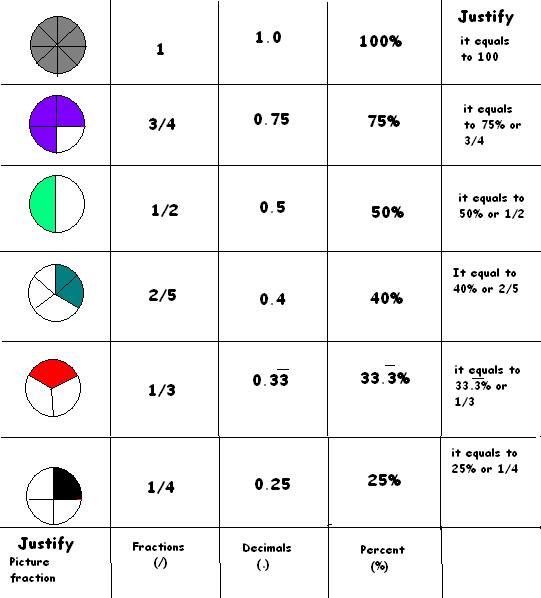
First Mr.H gave us a bag of papers that had pics of fraction, fractions, decimals, and percents. And we had to put them in order. As it is shown. After we had show it to Mr.H or Mr.Hanly. Then we had to write and draw the things on the paper. Then we had to explain our reasoning (across and down) as to why we put the symbols where we did. We had to do this in the justify row and the justify column. As it is shown in the picture. And don't forget to give this assignment a name. After we were done we had to take notes.

The notes:
Ratios tell how one number is related to another number. A ratio may be written as A:B or phrase "A to B." A ratio of 1:5 says that the second number is five times as large as the first. The following steps will allow determination of a number and teh ratio between the number is given.

Example: Determine the value of B if A=16 and the ratio of A:B = 2:5.

-Determine how many times the variable divisible by the corresponding portion of ratio (6/2=3).
-Multiply this number by the portion of the ratio representing b (3*5=15).
-Therefore if the ratio is A:b is 2:5, A=6 then B=15.


Homework:
If you didn't hand in the square roots sheets,tests with corrections, and the pink paper then hand it tomorrow.
On the sheet of paper that Mr.H gave us. Add in a row going down on ratios.

The Next scribe will be Matthew Q.